

Research & field stories
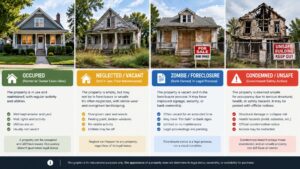
Abandoned vs vacant property comes down to care and legal status: a vacant property is simply unoccupied, while an abandoned property is unoccupied and neglected because the owner has stopped caring for it. A zombie property is vacant during an unfinished foreclosure, and a condemned property is one the government has declared unsafe or unfit to occupy.
An empty house doesn’t tell you its whole story. It might be a well-maintained rental between tenants, a property someone has walked away from, or a home awaiting foreclosure. An unsafe-building notice raises a separate question: whether anyone can legally occupy it. The four labels in abandoned vs vacant vs zombie vs condemned property point to different records, responsibilities, and risks.
The easiest way to separate them is to ask three questions: Does anyone live there? What’s happening with ownership or foreclosure? Has the government restricted the building’s use? One answer doesn’t settle the others.
This guide covers U.S. residential real estate. State laws, local ordinances, insurance contracts, and individual property orders can define these terms differently.
This guide covers U.S. residential real estate; for the broader picture, see our overview of abandoned houses in America. State laws, local ordinances, insurance contracts, and individual property orders can define these terms differently.
Abandoned, Vacant, Zombie, and Condemned Property at a Glance
These labels describe different aspects of a property. They are not four mutually exclusive categories.
| Property type | What the label primarily describes | Typical occupancy | What establishes the status? | Does the label mean nobody owns it? |
|---|---|---|---|---|
| Vacant | Occupancy | Unoccupied | Occupancy facts, subject to the definition being used | No |
| Abandoned | Owner disengagement, lack of use, or neglect | Usually unoccupied in this context | Circumstances and any applicable legal criteria | No |
| Zombie | Vacancy associated with an unfinished foreclosure | Vacant under the residential foreclosure definition used here | Vacancy information plus foreclosure records | No |
| Condemned | An official restriction or finding concerning an unsafe or unfit building | Occupancy may be prohibited or restricted | A government notice, determination, or order | No |
Census vacancy categories include ordinary situations such as homes for rent, homes for sale, and seasonal housing. ATTOM identifies residential zombie foreclosures through vacancy and foreclosure information. Unsafe-building status requires checking the relevant government record, not guessing from the exterior.
A simple way to remember the difference
Vacant means empty. Abandoned suggests someone has stopped taking responsibility. Zombie connects vacancy to unfinished foreclosure. Condemned points to an official building-safety or occupancy action. Use this as a memory aid, not a substitute for the applicable definition.
What Is a Vacant Property?
A vacant residential property is generally an unoccupied home. Vacancy alone doesn’t establish neglect, financial distress, or unsafe conditions. The Census Bureau separates vacant housing into categories that include homes available for rent or sale, homes awaiting occupants, and seasonal or occasional-use properties. Because those categories include ordinary situations, vacancy totals can’t tell you how many abandoned houses there are in the US.
Picture a seller who has moved out but still pays a landscaper and checks the house every week. That home is vacant but not abandoned. The empty driveway tells you less than the ongoing care.
Vacant doesn’t always mean the same thing to everyone
A housing survey, a city registration program, and an insurance policy serve different purposes. A classification from one doesn’t automatically apply to another.
Census guidance, for example, addresses how seasonal homes and certain temporarily occupied units enter housing statistics. Insurance guidance warns that vacancy or extended nonoccupancy can affect coverage. Your insurer’s policy wording needs its own review.
What should an owner check when a home becomes vacant?
Start with the insurance policy and the local property-maintenance requirements. Ask the insurer about notification, inspection, security, and winterization conditions rather than assuming your existing coverage works unchanged.
Then ask the municipality whether the property needs a vacant-building registration or license. Philadelphia has specific requirements for vacant properties, but those rules aren’t national standards.
What Is an Abandoned Property?
In ordinary real estate use, an abandoned property is one whose owner has withdrawn from using or caring for it. The reasons houses get abandoned vary widely. A legal determination is more specific: the government must apply the criteria in the relevant statute or ordinance. Washington’s mid-foreclosure nuisance law, for example, relies on listed outward indicators rather than a simple nationwide vacancy deadline.
“It looks abandoned” is an observation. “It qualifies as abandoned under this law” is a conclusion that requires evidence.
Signs that justify further investigation
Possible indicators, covered in more detail in our guide to the signs a house is really abandoned, include disconnected utilities, accumulated trash or mail, broken exterior doors or windows, and other signs that nobody is maintaining the building. Washington’s framework includes these kinds of conditions, but a single sign doesn’t establish abandonment everywhere.
Boarded windows are ambiguous. They may signal deterioration, but they can also show that someone has secured the building. New York’s Department of Financial Services specifically recognizes boarding as a possible protective measure for vacant and abandoned homes.
How long before a vacant property becomes abandoned?
There isn’t one U.S. deadline that turns every empty home into an abandoned property.
New York’s mortgage-related framework, for instance, considers inspections, occupancy evidence, maintenance, and specified alternative determinations. It also excludes certain diligently progressing renovations, secure seasonal homes, and other situations. Those are New York rules, not a national waiting period.
Does abandoned mean unowned?
No. Abandoning a building’s use is different from a completed transfer of ownership.
Adverse possession concerns land that someone else owns and requires meeting jurisdiction-specific conditions over a statutory period. Discovering an empty house doesn’t give you title to it. To see how unclaimed properties are typically handled, read what happens to abandoned houses nobody claims.
If you’re interested in buying, investigate the owner and the lawful sale process. Don’t start by entering, changing locks, or paying someone who can’t prove authority to sell.
What Is a Zombie Property?
A zombie foreclosure is a residential property that stands vacant before foreclosure finishes. ATTOM’s reporting definition focuses on properties whose owners have abandoned them before the foreclosure proceedings conclude. A stalled or canceled foreclosure can create this situation, but a documented stall isn’t required for every use of the term.
Not every zombie property involves a lender that has formally stopped foreclosure. Some remain in an ongoing process.
Zombie foreclosure versus zombie title
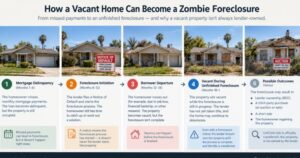
The related phrase zombie title describes the ownership problem that can arise when a borrower leaves, foreclosure remains incomplete, and the borrower still holds title. ATTOM’s glossary explains that homeowners may leave believing the lender has taken ownership even though foreclosure hasn’t finished.
An illustrative sequence looks like this:
- A borrower falls behind and receives foreclosure-related notices.
- The borrower moves out before the process finishes.
- The house remains empty while foreclosure continues, stalls, or stops.
- The borrower and lender’s legal positions don’t match what the borrower assumed.
The common error is treating a foreclosure notice as proof of a completed ownership transfer. The CFPB explains that foreclosure and post-sale eviction procedures vary by state, and that homeowners shouldn’t assume the start of foreclosure means they must immediately leave.
Zombie, foreclosed, and REO aren’t interchangeable
| Term | Practical meaning |
|---|---|
| Zombie foreclosure | A vacant property associated with foreclosure that hasn’t finished |
| Completed foreclosure | Foreclosure has reached completion under the applicable process; verify the resulting ownership documents |
| REO or bank-owned property | A property the lender owns after foreclosure |
| Scheduled foreclosure auction | A proposed sale event, not proof that the sale occurred or ownership transferred |
ATTOM distinguishes vacant properties still in foreclosure from vacant bank-owned properties after ownership has transferred to the lender. For a particular transaction, check the actual sale and title documents.
Who maintains a zombie property?
The answer isn’t always “the bank” or always “the borrower.”
New York imposes inspection and maintenance duties on covered mortgagees or servicers for qualifying vacant and abandoned properties. Those obligations show why title ownership and maintenance responsibility need separate investigation. They don’t establish a nationwide lender duty.
What Is a Condemned Property?
In the building-safety sense used here, a condemned property is one subject to an official determination or restriction because of unsafe, unfit, or otherwise prohibited conditions. Local agencies may use different terms. Philadelphia, for example, distinguishes violation notices, unsafe conditions, imminently dangerous conditions, and cease-operations orders.
Read the actual order. “Open code violation,” “unsafe structure,” “do not occupy,” and “demolition required” are different statements.
Safety condemnation isn’t the same as eminent domain
The word condemnation also appears in eminent-domain proceedings, where the government takes private property for public use and must provide just compensation under the applicable constitutional framework. That is a different issue from an unsafe-building order.
If a document uses “condemnation,” establish which meaning applies before drawing conclusions about ownership or compensation.
Does condemnation always require demolition?
No. Philadelphia’s guidance describes correcting violations or appealing, and its make-safe materials address repair work for unsafe structures as well as demolition-related circumstances. The available response depends on the condition, the order, and the local process.
For an owner, the immediate questions are practical:
- What activities or occupancy does the order prohibit?
- What must happen to correct the condition?
- What deadlines and appeal rights apply?
- Has the government authorized or scheduled demolition?
Get those answers from the issuing department. Beginning repairs or buying the property doesn’t automatically cancel an order.
Can you repair or buy a condemned house?
Treat either plan as a document-first project. Ask the building department to explain the required permits, professional assessments, inspections, and conditions for restoring lawful occupancy.
Philadelphia’s guidance shows why this review matters: certain repair and demolition work requires permits and licensed design professionals. A buyer needs the applicable local requirements, not a generic promise that the house is “repairable.”
How the Four Property Categories Overlap
One property can carry several labels because each answers a different question.
These hypothetical examples show the distinctions:
| Comparison | Example | What separates the labels? |
|---|---|---|
| Vacant vs abandoned | An empty home has regular maintenance; another has no evident care and meets the applicable abandonment criteria | Occupancy versus disengagement and legal criteria |
| Abandoned vs zombie | A neglected empty home has no mortgage foreclosure; another stands vacant during foreclosure | Abandonment doesn’t require foreclosure |
| Abandoned vs condemned | A deserted building has no unsafe-building order; another has one | Neglect versus official action |
| Vacant vs condemned | A safe home awaits a tenant; a fire-damaged home has an occupancy restriction | Being empty versus a government restriction |
| Zombie vs condemned | A vacant home awaits foreclosure completion but has no safety order; another also has an unsafe-building order | Foreclosure status versus building-safety status |
The underlying definitions come from separate housing, foreclosure, abandonment, and code-enforcement frameworks. None makes the other investigations unnecessary.
A property could be vacant, qualify as abandoned, remain in unfinished foreclosure, and carry an unsafe-occupancy order at the same time. That combination calls for four separate checks.
What Do Vacant Condemned Building and Abandoned Dwelling Mean?
A vacant condemned building is a building that is empty and subject to an official order because it is unsafe or unfit to occupy. The vacant part describes occupancy, and the condemned part describes the restriction the government imposed, so the same building can be vacant, condemned, and still have an owner.
An abandoned dwelling is a home whose owner has stopped using or caring for it. Dwelling is the word housing and legal sources often use for a place where someone lives, so an abandoned dwelling is the same idea as an abandoned property, stated with the housing term.
How to Identify a Property’s Actual Status
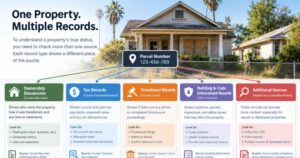
Investigate the property by address and parcel number, not by appearance alone. The following workflow keeps observations separate from conclusions.
1. Observe from a lawful location
Note visible damage, maintenance, posted notices, and the date of your observation. Don’t enter the lot or building to investigate.
An empty driveway or closed blinds is a reason to ask questions, not proof that nobody lives there.
2. Identify the parcel and apparent owner
Start with the local assessor or property-appraiser office to identify the parcel. Then request the relevant recorded ownership documents.
For a purchase, ask a title professional to verify current ownership and the seller’s authority. A tax mailing address isn’t the end of the investigation.
3. Request the government’s property file
Ask code enforcement or the building department for open violations, inspection findings, occupancy restrictions, repair orders, demolition actions, and related charges.
Philadelphia’s enforcement guidance shows why the specific notice matters: different violation and order types carry different consequences and response procedures.
4. Verify foreclosure separately
Ask which court, recording office, or trustee records establish the foreclosure status in that jurisdiction. The CFPB recommends checking local sources because state foreclosure processes differ.
For a purchase, request confirmation of whether a scheduled sale occurred and what documents establish the resulting ownership.
5. Resolve contradictions before proceeding
If the listing says “bank-owned” but the ownership documents show an individual borrower, pause. If the seller says “minor violations” but the city file includes a demolition action, pause again.
The goal is to reconcile the records, not to pick the most convenient description.
Buying a Vacant, Abandoned, Zombie, or Condemned Property
Match your due diligence to the unresolved problem. An empty house with a cooperative seller calls for a different investigation than a property with disputed ownership and an active demolition case. For the main ways these properties come to market, see our guide to abandoned houses for sale.
| Property description | Your first purchase question |
|---|---|
| Vacant | What happened while the home stood empty, and can I inspect it fully? |
| Abandoned | Who can legally sell it, and what obligations need resolution? |
| Zombie | What’s the current foreclosure and ownership status? |
| Condemned | What exactly does the government require, and can my proposed project satisfy it? |
Treat the table as a starting point, not a substitute for professional review.
Understand the sale mechanism
A private purchase, foreclosure auction, tax-related sale, and land-bank transaction aren’t interchangeable.
Community Progress explains that delinquent-tax enforcement may involve selling a right to collect unpaid taxes or foreclosing and selling the real estate, depending on state law. Land banks also set their own disposition policies and programs.
Before bidding, ask: Am I buying real estate, a lien, or another legal interest? What must happen before I can obtain possession and carry out my plan?
Build a property-specific due diligence file
Before making a binding commitment, request professional review of:
- Ownership and authority: Current ownership documents, competing claims, and the seller’s authority to sign.
- Debts and enforcement: Taxes, liens, applicable assessments, violations, and government orders.
- Physical condition: A permitted inspection plan and specialist assessments where needed.
- Project approval: The intended use, required permits, and the route to lawful occupancy.
- Financial feasibility: Written purchase, repair, insurance, financing, and carrying-cost estimates.
Ask the title professional and attorney to explain which obligations the transaction resolves and which could remain. “Auction” doesn’t mean “clean title.”
Run the whole budget
Use this planning equation:
Acquisition + closing + investigation + repairs + permits + financing + insurance + carrying costs + contingency = total project budget.
As an illustrative budget, a $65,000 purchase plus $105,000 in repairs and $30,000 in other costs totals $200,000 before any additional contingency. Judge the whole project, not the asking price.
For repair versus demolition, request written estimates for both paths and confirm what the municipality permits. A universal repair-cost percentage can’t substitute for that analysis.
Financing and Insurance: Check Before You Commit
A renovation loan may help, but eligibility still matters
HUD’s FHA Section 203(k) program can combine an eligible purchase or refinance with rehabilitation in one mortgage. The program includes Standard and Limited options, and eligible improvements can include structural and building-system repairs.
That doesn’t mean every distressed house, borrower, or investment plan qualifies. Ask an FHA-approved lender to review the actual property, proposed work, occupancy plan, and current program requirements. HUD identifies the program as available through participating FHA-approved lenders.
Get the lender’s property-specific response before relying on the loan in an offer.
Vacancy can change insurance coverage
The Maryland Insurance Administration warns that leaving a home vacant or unoccupied can affect some or all coverage. Current premiums don’t guarantee the policy still fits.
Describe the property accurately when seeking a quote: occupancy, contents, utilities, damage, government orders, and planned work. Ask for written confirmation of the coverage, exclusions, inspection conditions, and effective date.
Don’t rely on a universal “30-day” or “60-day” rule. Read the contract that applies to your property.
Why Neglected Properties Matter to Neighbors, and How Communities Respond
Neglected vacant properties can create safety hazards and additional demands on local governments. New York’s Department of Financial Services identifies health and safety concerns, criminal activity, effects on nearby property values, and added public-service costs among the problems associated with deteriorated zombie properties. Not every empty home creates the same harm, and where these problems concentrate varies by place; see the cities with the most abandoned houses.
For neighbors, the most useful report describes a specific condition: an unsecured entrance, falling material, accumulated waste, or another observable hazard. Community Progress recommends identifying the local code-enforcement entity responsible for addressing a particular problem property.
Code enforcement, tax enforcement, and land banks do different jobs
Code enforcement addresses compliance with building and property standards. Delinquent-tax enforcement seeks payment and can lead to different sale processes under state law. A land bank’s acquisition and reuse work is a third, separate function.
Land banks are public entities that acquire and hold problem properties, care for them, and transfer them to responsible owners according to community goals. Their powers depend on state law.
A land-bank listing deserves its own review. Ask about buyer qualifications, development obligations, deadlines, and any restrictions before assuming it works like an ordinary listing.
[Image placeholder] Original community-response flowchart with separate branches for immediate hazards, code violations, tax delinquency, and potential land-bank reuse. Purpose: Help readers identify the appropriate local office instead of assuming one agency handles every problem. Alt text: “Local responses to unsafe, neglected, and tax-delinquent properties” Image query: “Create community property response flowchart code enforcement taxes land bank”
The Best Next Step: Verify the Property, Not the Label
The practical difference between abandoned, vacant, zombie, and condemned property comes down to occupancy, owner engagement, foreclosure, and government action. A label can tell you where to begin, but the underlying records determine what you’re dealing with.
Before buying, entering, renovating, or making ownership assumptions, assemble one property-specific file: ownership documents, foreclosure information, tax and lien review, and the complete building-enforcement record. Resolve conflicts before you commit money.
Frequently Asked Questions
Is every vacant house abandoned?
No. Census vacancy categories include homes for rent or sale, homes awaiting occupants, and seasonal housing. Vacancy doesn’t establish owner disengagement or neglect.
Does a zombie property require a stalled foreclosure?
Not under every definition. ATTOM classifies zombie foreclosures around vacancy before foreclosure completion; the process doesn’t have to be formally canceled.
Can a condemned property still have an owner?
Yes. An unsafe-building enforcement action can require an owner to correct conditions or respond through an appeal. This process is separate from government acquisition through eminent domain.
Can you claim an abandoned house by paying its taxes?
Probably not. Adverse possession requires jurisdiction-specific elements and possession for the required statutory period. Paying taxes alone doesn’t satisfy that full framework.
Does an unsafe-building notice mean demolition is inevitable?
No. The available response depends on the notice and local process. Philadelphia, for example, provides procedures for correcting violations and undertaking make-safe work, alongside demolition enforcement. (
Where should you report a neglected empty house?
Identify the local office responsible for code enforcement and report the specific conditions you observed. Community Progress recommends contacting that local entity for help with a particular vacant building or lot.
What is the difference between abandoned vs vacant property?
A vacant property is unoccupied. An abandoned property is unoccupied and neglected because the owner has stopped caring for it. Abandoned vs vacant property is the difference between an empty home and a neglected one: every abandoned property is vacant, but not every vacant property is abandoned.
What does a vacant condemned building mean?
It means a building is empty and officially restricted because it is unsafe or unfit to occupy. The vacancy describes occupancy, and the condemnation is the government order. The building can still have an owner, and the order, not the vacancy, decides whether anyone may enter or live there.
What does abandoned dwelling mean?
An abandoned dwelling is a home whose owner has stopped using or caring for it. Dwelling is simply the housing and legal word for a home, so an abandoned dwelling is the same idea as an abandoned property. Whether it meets a legal definition of abandonment still depends on the law that applies.

AbandonedHouse
We explore the history, architecture and context behind America’s overlooked places through research-led storytelling and responsible documentation.
More stories for curious minds
Tax Lien vs Tax Deed States: Full List by State (2027)
Every state has a way to collect unpaid property taxes. Some sell a claim on the house. Others…
Housing Vacancy Rates by State in 2027: Highest and Lowest.
Housing vacancy rates by state range from 6.5% in Connecticut to 19.5% in Maine, according to the 2025…