
Research & field stories
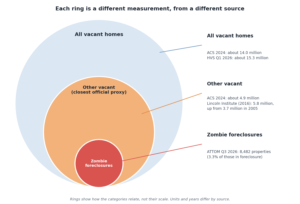
How many abandoned houses in the US are there? No one knows exactly, because no federal agency counts abandoned houses and no single national definition exists. The closest official proxy is about 4.9 million other vacant homes in the 2024 Census survey, while total vacant homes numbered about 14.0 million, and most vacant homes are not abandoned.
Nobody knows exactly how many abandoned houses sit in the United States. No federal agency counts them, and no national definition exists.
You can find three kinds of numbers. The Census Bureau counts vacant homes. Private data companies such as ATTOM count specific distressed properties, like foreclosures the owner walked away from. Researchers estimate “effectively abandoned” homes from proxies such as the Census “other vacant” category and postal data.
Each measures something different. This guide explains what each number means, which one fits which question, and how to check a single property yourself.
The headline vacancy number is far larger than any abandonment estimate.
The Short Answer: The National Numbers Explained
The claim that 14 to 15 million U.S. homes sit empty is a vacancy figure. It counts vacation cabins, apartments between tenants, and houses listed for sale alongside the neglected ones.
The closest official proxy is the Census Bureau’s “other vacant” category. In the 2024 American Community Survey it came to about 4.9 million units. That figure points toward abandonment without counting it.
What the Latest Housing Statistics Show
The Census Bureau publishes two main kinds of vacancy data.
- American Community Survey (ACS): An annual survey that estimates total housing units, vacant units, and the reason each one is vacant.
- Housing Vacancies and Homeownership Survey (HVS): A quarterly survey that reports the rental vacancy rate and the homeowner vacancy rate.
| Measure | Figure | Source and period |
|---|---|---|
| Total housing units | About 146.7 million | ACS 1-year, 2024 |
| Total vacant units | About 14.0 million (9.5%) | ACS 1-year, 2024 |
| Vacant for rent | About 2.8 million | ACS 1-year, 2024 |
| Vacant for sale only | About 849,000 | ACS 1-year, 2024 |
| Seasonal, recreational, or occasional use | About 4.3 million | ACS 1-year, 2024 |
| Other vacant | About 4.9 million | ACS 1-year, 2024 table B25004 |
| Total vacant units, 2020 Census | 13.7 million of 140.5 million (9.7%) | 2020 Census, Census Day count |
| Total vacant units, quarterly | About 15.3 million | HVS, Q1 2026 |
| Rental and homeowner vacancy rates | 7.3% and 1.2% | HVS, Q2 2026 (released July 28, 2026) |
The ACS and HVS totals differ by more than a million units because the two surveys use different methods and dates. Write down the survey, the year, and the release date next to every number. A quarterly rate and an annual estimate don’t compare directly. The next HVS release is scheduled for October 28, 2026.
Why a Vacant Home Isn’t an Abandoned House
Consider who owns an empty house. It might belong to a family that spends summers in Michigan and winters in Florida. It might belong to a landlord who is repainting between tenants, or to an heir waiting on probate. Many of these homes are well kept and will have residents again soon.
Abandonment means the owner has effectively walked away from the property and its upkeep. Most vacant homes never reach that point.
The Closest Available Estimate
Alan Mallach’s 2018 Lincoln Institute of Land Policy report, The Empty House Next Door, used the Census “other vacant” category as a stand-in for effectively abandoned housing. It found that the number rose from 3.7 million in 2005 to 5.8 million in 2016. The ACS counted about 4.9 million in 2024. Treat these as method-specific estimates for their own years. They aren’t a current tally of abandoned homes.
How Many Abandoned Houses in the US Today?
How many abandoned houses in the US are there today? The latest figures still give no exact count, but they set the range. About 15.3 million homes were vacant in the first quarter of 2026, from the Census Bureau Housing Vacancies and Homeownership Survey, and about 4.9 million were other vacant in the 2024 American Community Survey. ATTOM counted 8,482 zombie foreclosures in the third quarter of 2026.
None of those figures counts abandoned houses directly. A vacant home may be for sale, for rent, or seasonal, and a truly abandoned home can sit in any of those groups, so the latest numbers are a starting point, not a tally.
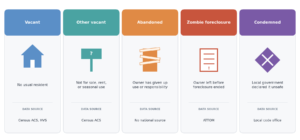
Abandoned, Vacant, “Other Vacant,” Zombie Foreclosure, Condemned: What’s the Difference?
People use these terms interchangeably, and they shouldn’t. Our guide to abandoned vs. vacant vs. zombie vs. condemned property explains each in more depth.
| Term | What it means | Main data source | Good proxy for abandonment? |
|---|---|---|---|
| Vacant | No one lives there as a usual residence | Census ACS and HVS | No. It’s too broad. |
| Other vacant | Vacant, and not for sale, not for rent, and not seasonal | Census ACS | Partly. It’s a starting clue. |
| Abandoned | The owner has effectively given up use of, or responsibility for, the property | No single national source | Varies by local definition |
| Zombie foreclosure | The owner left while the foreclosure was still unfinished | ATTOM | Yes, for one narrow slice |
| Condemned | A local government declared the building unsafe | Local code enforcement | No. It’s a legal status, and it says nothing about who is using the property. |
A quick visual reference for terms that are easy to confuse.
What Is an Abandoned House?
An abandoned house is a home the owner has effectively given up on. In practice, it’s a property whose owner has stopped maintaining it, paying for it, or using it. The owner may be gone, deceased, or unreachable. Some owners decide the house isn’t worth what it costs to keep.
Legal abandonment sets a higher bar than “it looks abandoned.” Each state and city defines it differently, and a house with overgrown grass still has an owner.
What Counts as a “Vacant Housing Unit” to the Census?
A housing unit is vacant if nobody is living in it at the time of the survey. The Census sorts vacant units into seven categories:
- For rent
- For sale only
- Rented but not yet occupied
- Sold but not yet occupied
- Seasonal, recreational, or occasional use
- Migrant worker housing
- Other vacant
What Are “Other Vacant” Units?
This is the catch-all category for homes held off the market for reasons that fit nowhere else. Those reasons include repairs or renovation, foreclosure, a family situation, legal proceedings, and abandonment or possible condemnation. Some are unknown.
Because the category mixes all of them, you can’t read it as “abandoned.” You can read it as the place where abandoned homes show up when they’re counted at all.
What Is a Zombie Foreclosure?
A zombie foreclosure starts when a homeowner leaves because of foreclosure and the lender never finishes the process. Legal title stays with the former owner, who often doesn’t know the bank stalled. Nobody maintains the house.
ATTOM tracks these. In the third quarter of 2026 it counted 8,482 zombie properties, which was 3.3% of the 259,666 homes in foreclosure. They form a measurable group, but only a small subset of all abandoned homes.
Condemned and Distressed Homes
Condemned means a local authority has deemed a building unsafe to occupy. Distressed is a looser term for a property in poor condition or financial trouble.
A home can be condemned and still have an engaged owner. It can also be abandoned without ever being formally condemned. Keep the labels separate.
What the Major Data Sources Show
Each source below has its own units and purpose. Don’t add their numbers together.
Census Bureau Vacancy Estimates
The ACS gives annual estimates of vacant units by reason. The HVS gives quarterly vacancy rates for rental and owner-occupied housing. Both measure vacancy only.
What the 2020 Census and ACS Show About “Other Vacant” Homes
The 2020 Decennial Census and the ACS both report “other vacant” units, and they’re different tools. The decennial census is a full count taken on April 1, 2020. The ACS is a survey estimate with a margin of error.
2020 Census
13.7 million vacant units out of 140.5 million total, including 4.4 million for seasonal, recreational, or occasional use. Pull the 2020 “other vacant” count from the census.gov occupancy and vacancy tables.
ACS 2024 1-year
About 4.9 million “other vacant” units, from table B25004 on data.census.gov.
ATTOM’s Vacant Property and Zombie Foreclosure Data
ATTOM works from county tax assessor records and property data, not household surveys. Its unit is a property, while the Census counts housing units, so direct comparison breaks down.
Third-Quarter 2026 Report
ATTOM released the report on August 28, 2026. It found that 1.3% of 104.6 million residential properties were vacant.
Vacancy by State
Oklahoma and Kansas had the highest state vacancy rates at 2.4%, and 19 states had rates below 1%.
Zombie Rates by Metro
Among large metros, Youngstown (12.1%), Cedar Rapids (11.6%), and Baltimore (11.5%) had the highest shares of foreclosures that were vacant.
Investor-Owned Homes
Investors held more than their share of vacant homes: 879,532 of the 24.9 million institutionally owned properties were vacant, a 3.5% rate.
Researcher Estimates of Effectively Abandoned Homes
Researchers at the Lincoln Institute and elsewhere combine Census data with U.S. Postal Service address data to find homes that appear empty for the long term. These estimates show how big the problem may be. They aren’t official counts, and older ones describe the past.
Why These Numbers Can’t Be Added Together
- The Census counts housing units, ATTOM counts properties, USPS counts mail addresses, and researchers count whatever their method defines.
- Surveys, property records, and mail data cover different time periods.
- Categories overlap. A zombie foreclosure may also sit inside “other vacant.”
- Adding them double-counts some homes and misses others.
Why There’s No Exact National Count
- No shared definition. Abandonment is a legal and local concept.
- Survey limits. The Census asks about vacancy and ignores the owner’s intent. Interviewers classify what they see, so the “abandoned or possibly condemned” label is a judgment call. Severely deteriorated or condemned buildings may not count as housing units at all.
- Imperfect proxies. Data built for other purposes can mislead when repurposed.
- Different dates. A 2020 count and a 2026 estimate describe different housing markets.
How HUD and USPS Address Data Are Used
HUD works with USPS to make address-vacancy data available to researchers and local governments. An address is flagged as vacant when mail hasn’t been collected for 90 days or longer. USPS also uses a “no-stat” label for addresses such as homes under construction or rural addresses that have sat empty for 90 days.
A flag points to a house worth a closer look. A snowbird’s winter home, a long hospital stay, or a renovation can all trigger it. HUD researchers have also found that USPS vacancy estimates often run lower than the ACS for the same area, so the two sources don’t line up neatly.
Local Property Records and Field Verification
Cities and counties have better tools than any national dataset. They use tax records, code-enforcement files, utility shutoffs, and vacant-property registries, and then someone visits to see what’s happening. No single indicator proves legal abandonment, but records plus an on-site check get you much closer. Our guide to the signs a house is really abandoned lists what to look for.
Where Vacancy and Abandonment Are Most Common
Geography changes the story, and mixing up rates with raw counts causes most of the mistakes.
States With High Vacancy Rates and Large Vacant Counts
A state can have a high vacancy rate because it has many vacation homes. A different state can have the most vacant homes simply because it’s large. Those produce different rankings, so use one dataset and one year when you compare.
In 2024, Maine, Vermont, and Alaska had the nation’s highest gross vacancy rates, and Maine’s was about one in five homes. Among the 75 largest metros, Cape Coral-Fort Myers, Florida, had the highest rate at 34.1% and New Haven-Milford, Connecticut, the lowest at 4.0%. Seasonal homes drive much of that gap.
Cities With Persistent Vacancy and Hypervacancy
Some cities have blocks where a large share of properties sit empty for years. Mallach’s Lincoln Institute report calls this hypervacancy, meaning at least one in five properties is vacant. It focuses on legacy cities that lost population and industry over decades, such as Detroit, Cleveland, and St. Louis. Vacancy in these places shifts as demolition, rehab, and new construction change neighborhoods, so date any city figure you cite. For a closer look at specific places, see the cities with the most abandoned houses.
Regional Patterns
Vacation Areas
Seasonal homes drive high vacancy rates.
The Deep South and Appalachia
Parts of both regions often show higher “other vacant” shares, with older housing, heirs’ property issues, and weaker markets as likely causes.
Rural Areas Losing Population
Houses stay empty when no buyer comes along.
Legacy Cities in the Midwest and Northeast
These cities live with long-term vacancy after industrial decline. ATTOM’s zombie-foreclosure rankings point the same way.
Why a High Rate Doesn’t Always Mean More Abandonment
A beach town and a shrinking mill town can show the same vacancy rate for opposite reasons. Check the “other vacant” share and local code-enforcement data instead of the headline rate, and keep zombie-foreclosure data separate.
Why Houses Get Abandoned
No reliable national data says what share of abandonments comes from each cause. The mechanisms behind why houses get abandoned are well documented, though.
Foreclosure and Mortgage Distress
When owners can’t pay, some leave before the lender completes foreclosure. The result is a zombie foreclosure, where nobody mows the lawn or fixes the roof. The wave after the 2008 housing crash left many such homes, but it doesn’t explain every case.
Death, Inheritance, and Ownership Disputes
Heirs may disagree about what to do. Probate can take months or years, and sometimes nobody opens an estate. The roof leaks while the house waits. Unclear title makes it worse, because no one can legally sell.
Unpaid Property Taxes and Liens
Back taxes and liens can exceed what a run-down house is worth, and owners may stop paying and walk away. The debt stays attached to the property, which makes it hard for anyone else to take it on.
Repair Costs and Code Violations
A house that needs a new roof, foundation work, or mold remediation can cost more to fix than it’s worth, especially in a weak market. Code fines pile up, and the owner often has no good option.
Population Loss and Disinvestment
When people leave an area and demand falls, prices drop below repair costs and banks stop lending. Neighbors move out, and the cycle feeds itself.
How Abandoned Houses Affect Communities
Effects depend on the property and the neighborhood. One tidy empty house on a busy street does little harm. A cluster of deteriorating ones can change a block.
Blight and Property Values
Research from sources such as the Lincoln Institute links persistent vacancy and visible deterioration to weaker neighborhood conditions and pressure on nearby home values. The size of the effect varies by place, so avoid quoting one universal figure.
Municipal Costs and Public Safety
Cities pay for mowing, boarding, inspections, and demolition, and they lose property tax revenue when owners stop paying. Vacant buildings can attract illegal dumping, fires, and crime, although conditions differ widely from place to place.
Homelessness and the Housing Shortage
It’s tempting to say “just house people in the empty homes.” Vacant homes are often in the wrong place, in poor condition, too expensive to restore, or tied up in legal disputes. Millions of vacant units don’t translate into millions of homes available to people who need one.
Rehabilitation, Demolition, and Reuse
Some properties can be saved. Others are better demolished, with the land turned into side lots, gardens, stormwater parks, or new housing. The right call depends on the structure, the ownership, and the local market. Cleveland, for example, cataloged green uses for vacant land and worked with a nonprofit partner to give $500,000 in grants to 56 small parks, rain gardens, and agricultural projects.
How Abandoned Houses Are Identified and Counted
Researchers and local governments layer several kinds of evidence.
- Census, ACS, and HVS data: These give the big picture and can’t point to a specific house.
- USPS address data: This flags addresses with no mail pickup for 90 days or more, which warrants a closer look.
- Tax and code records: Delinquent taxes, repeated violations, and registry listings are red flags.
- Field checks: Someone inspects the property in person.
Definitions differ by jurisdiction, so what counts as “abandoned” in one city may not count in the next.
What Can Be Done About Abandoned Houses
Outcomes vary by owner and place; see what happens to abandoned houses nobody claims for the usual paths.
Code Enforcement, Tax Enforcement, and Vacancy Registries
Cities can cite owners for violations, pursue tax foreclosure, and require owners of vacant buildings to register them. A registry gives the city a contact person and sometimes collects a fee.
Vacancy and Blight Taxes
Some places tax long-vacant or blighted properties more heavily to push owners to sell or fix them. Research suggests these taxes help but don’t solve the problem alone.
Receivership and Land Banks
In receivership, a court appoints someone to rehab or sell a neglected property. Land banks are public or nonprofit entities that acquire tax-delinquent and vacant properties, clear titles, and return them to use. Availability and powers vary by state.
Rehabilitation Incentives and Demolition
Grants, tax breaks, and low-cost loans can make rehab pencil out. Where a building is too far gone, demolition may be the better public choice.
Can You Buy an Abandoned House?
You can’t claim one by moving in. An abandoned-looking house still has an owner on record, a lender, an estate, or the government behind it, and living there without legal title can amount to trespassing.
Legitimate routes depend on how the property reached its condition, and our guide to abandoned houses for sale covers them in more detail:
- Foreclosed: Buy through the lender or at auction.
- Tax-delinquent: Buy through a county tax sale, and check your state’s redemption rules first.
- Government- or land-bank-owned: Apply through the agency’s program.
- Privately owned and vacant: Contact the owner, or work with an attorney.
Before any purchase, verify ownership and title, search for liens, check for code violations, and learn the local acquisition rules. Those rules differ sharply from state to state.
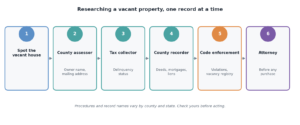
How to Find Vacant or Potentially Abandoned Properties
No single national database lists every abandoned property, so start local.
- County assessor: Owner name, mailing address, and assessed value.
- County recorder: Deeds, mortgages, and liens.
- Tax collector: Delinquency status.
- City code-enforcement office: Violations and vacant-property registry listings.
- Sheriff’s office or court: Foreclosure sale notices.
- Local land bank: Properties available for acquisition.
The research process as a checklist.
Frequently Asked Questions
How many vacant homes are in the U.S.?
The ACS counted about 14.0 million vacant units in 2024, and the HVS put the total near 15.3 million in the first quarter of 2026. Those are vacant homes, and most are for rent, for sale, seasonal, or between occupants.
Is there an official count of abandoned houses?
No. The Census tracks vacancy, ATTOM tracks specific distressed properties, and researchers estimate with proxies. None of them is a definitive national count.
What does “other vacant” mean in Census data?
It’s the vacancy category for homes that aren’t for sale, for rent, or seasonal. The reasons include repairs, foreclosure, family situations, and abandonment or possible condemnation.
Which state has the highest vacancy rate?
Maine had the highest gross vacancy rate in 2024, followed by Vermont and Alaska. Rates run highest where vacation homes are common, which says little about how many houses are abandoned.
What is a zombie foreclosure?
A home the owner left before the foreclosure was finished. It’s a subset of abandonment, and ATTOM counted 8,482 of them in the third quarter of 2026.
Are vacant homes available to buy?
Not automatically. A vacant home has an owner, and it may be in foreclosure, probate, or tax delinquency. You need to find out which, then use the proper channel.
How can I find information on an abandoned property?
Use county assessor, recorder, and tax collector records, plus city code enforcement and any local land bank. Procedures vary by jurisdiction.
How many abandoned houses in the US today?
There is still no exact count. The latest figures are about 15.3 million vacant homes in the first quarter of 2026 and about 4.9 million other vacant homes in 2024. Neither figure counts abandoned houses directly.
Why are there so many abandoned houses in the USA?
The causes are mostly local: foreclosure and mortgage distress, death and inheritance disputes, unpaid property taxes, repair costs higher than the home is worth, and population loss in areas where demand has fallen. No national data says how much each cause contributes.
How many abandoned houses are in America?
There is no separate count for America, because the question means the United States. The closest figures are about 14.0 million vacant homes in 2024 and about 4.9 million other vacant homes. Most vacant homes are not abandoned.
The Bottom Line
Nobody can say for certain how many abandoned houses the U.S. has. The best approach is to read each data source for what it measures, then check local records for any specific property you care about. For the wider picture, see our overview of abandoned houses in America.

AbandonedHouse
We explore the history, architecture and context behind America’s overlooked places through research-led storytelling and responsible documentation.
More stories for curious minds
Pros and Cons of Buying an Abandoned House
A run-down house with a low price can look like a steal, and the pros and cons of…
How to Buy an Abandoned House: Step-by-Step (US)
How to buy an abandoned house: find a property, identify the owner through county assessor and tax records,…