
Research & field stories
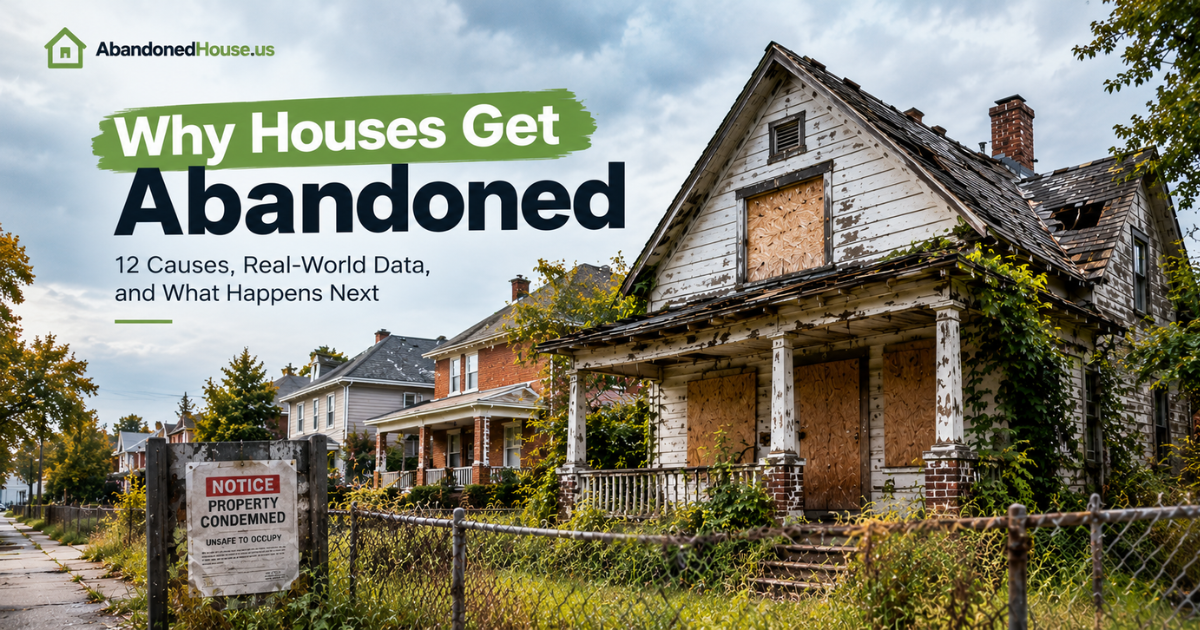
Why are houses abandoned? Houses get abandoned when owners stop maintaining, paying for, or claiming them, usually after foreclosure, unpaid taxes, costly repairs, a death in the family, or a local market collapse. An abandoned house is a home its owner has left without a plan to return, sell, or repair it.
Drive through almost any struggling neighborhood and you will probably pass one: knee-high grass, boarded windows, a notice taped to the door.
It is easy to assume the owner just walked away. The records usually tell a messier story.
Most abandoned homes trace back to money problems, family disputes, legal disputes, or a market where the house is worth less than the repairs would cost.
No one knows exactly how many there are. The Census Bureau counted 13.7 million vacant housing units in 2020. That count includes vacation homes, rentals between tenants and houses for sale.
ATTOM, a property-data company, counted 8,482 homes in the third quarter of 2026 that owners had left partway through foreclosure.
Neither figure is a count of abandoned houses. This guide covers 12 common causes why houses get abandoned, what the data can and can’t show, and how communities recover these properties.
What Does It Mean When a House Is Abandoned?
There is no single legal definition. An abandoned house is generally one whose owner has stopped maintaining it, paying for it or claiming it, and who isn’t using or marketing it.
Cities and states define the term differently. Some look at unpaid utilities, code violations or a lack of occupancy over a set period.
HUD’s research summary notes that the absence of universal definitions of vacancy and abandonment makes these properties hard to count nationally.
Abandoned vs. Vacant vs. Foreclosed vs. Condemned
These terms get mixed up. Here is a quick reference, and our guide to abandoned vs. vacant vs. zombie vs. condemned property goes deeper.
| Term | What it means | Key point |
|---|---|---|
| Vacant | No one lives there | Can be temporary and well maintained |
| Abandoned | The owner has stopped maintaining or claiming it | Describes the property’s condition and the owner’s behavior |
| Foreclosed | A lender is taking, or has taken, the property through a legal process | A legal status, not a condition |
| REO | “Real estate owned” by a lender after a failed foreclosure sale | Bank-owned |
| Condemned | A local government has declared it unsafe to occupy | An official order |
| Zombie foreclosure | The owner left, but the foreclosure was never completed | Ownership stays unresolved |
Two related terms come up often. A blighted property is one in poor condition that harms its surroundings.
A distressed property is a broader label for homes in or near foreclosure, delinquency or serious disrepair.
Why an Empty House Isn’t Always an Abandoned House
Many empty homes are in good shape. They may be listed for sale or rent, used as vacation homes, or under renovation. The Census Bureau sorts vacant units into seven categories.
One of them, “other vacant,” covers units that are not for rent, not for sale and not seasonal. In the 2020 Census it held 3.4 million units, about a quarter of all vacant units.
The Bureau says the category includes homes being repaired or renovated, homes held for a caretaker, and bank-owned properties not yet on the market.
It adds that a high share can also mean a census taker had trouble determining a unit’s status.
Abandoned homes fall into this group, and so do many homes that are not abandoned. “Other vacant” is a rough proxy at best.
How Many Homes Are Vacant or Abandoned in the United States?
Nobody knows exactly, and anyone quoting a single confident number deserves skepticism.
Each source counts something different, over a different period, in different places, so the figures below can’t be added together or compared directly. For a fuller look at the national picture, see our overview of abandoned houses in America.
The Latest Vacancy Statistics
In the 2020 Census, 13.7 million of 140.5 million housing units were vacant (9.7%). The largest group was seasonal, recreational or occasional-use homes at 4.4 million.
Next came 3.8 million units for rent and 3.4 million classed as other vacant (U.S. Census Bureau).
The Census Bureau’s Housing Vacancy Survey tracks vacancy in the for-sale and for-rent stock every quarter.
Its second-quarter 2026 release, published July 28, 2026, put the rental vacancy rate at 7.3% and the homeowner vacancy rate at 1.2% (Census Bureau press release).
These rates measure how much housing is available on the market. They are not counts of abandoned houses.
The American Community Survey adds yearly estimates of vacant units by reason, including “other vacant” (table B25004 on data.census.gov).
What Foreclosure and Zombie Foreclosure Data Show
ATTOM’s third-quarter 2026 report, released August 28, 2026, analyzed county tax assessor data for about 104.6 million residential properties.
It found that 1.3% were vacant, the same share as in the previous quarter and in the third quarter of 2025.
Of 259,666 properties in foreclosure, about 3.3%, or 8,482, were “zombies,” meaning the owners had abandoned them before the foreclosure ended (ATTOM).
The 1.3% figure covers all residential properties in ATTOM’s data, whatever their foreclosure status.
The zombie figure covers only homes already in foreclosure, so it leaves out abandoned houses that never entered that process.
Why There Is No Single National Count
Census figures come from the decennial count and household surveys. ATTOM draws on public records.
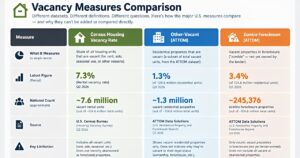
City counts often come from inspections or registries. This table shows what each measure covers.
| Measure | Source and period | Figure | What it measures | Limitation |
|---|---|---|---|---|
| All vacant units | 2020 Census (April 1, 2020) | 13.7 million (9.7% of housing units) | Every unoccupied housing unit | Includes seasonal homes, rentals and homes for sale |
| “Other vacant” units | 2020 Census | 3.4 million (24.6% of vacant units) | Vacant units outside the other six categories | Includes many homes that are not abandoned |
| Rental and homeowner vacancy | Census Housing Vacancy Survey, Q2 2026 | 7.3% rental, 1.2% homeowner | Vacancy within the for-rent and for-sale stock | Excludes homes that are off the market |
| Vacant residential properties | ATTOM, Q3 2026 | 1.3% of about 104.6 million | Unoccupied residential properties, any foreclosure status | Proprietary data; vacant does not mean abandoned |
| Zombie foreclosures | ATTOM, Q3 2026 | 8,482 (3.3% of 259,666 foreclosures) | Homes abandoned before foreclosure was completed | Counts only properties in foreclosure |
12 Reasons Houses Get Abandoned in the United States
This list isn’t ranked. No reliable national source says which cause is most common. Treat it as a way to organize the causes, not as a measure of how often each one occurs.
Mortgage Default and Foreclosure
When owners can’t make payments after a job loss, illness or divorce, some move out before the process ends. Foreclosure can take months or years, depending on the state.
Some states foreclose through the courts and others don’t, which affects how long a house can sit unresolved. If the lender never completes the foreclosure, the result is a zombie foreclosure.
The former owner is gone but still legally owns the home. The lender may not have taken title, so nobody mows, repairs or secures it.
Unpaid Property Taxes and Tax Liens
Delinquent taxes, penalties and interest pile up. Eventually a local government may sell a tax lien or foreclose.
Procedures vary widely by state: some sell liens to investors, others sell the deed itself, and some give owners long redemption periods.
A house in that window often sits untouched, because nobody wants to put money into a property whose ownership may change.
Expensive Repairs and Structural Damage
A leaking roof leads to rotted decking, then mold, then a failing ceiling. Deferred maintenance compounds.
When repairs would cost more than the house could sell for, owners may stop paying for them. That is most common in low-value markets: picture a house worth $60,000 that needs $90,000 of work.
Death of the Owner and Probate Delays
When an owner dies, the house legally belongs to the estate until a court or other legal process transfers it.
If nobody opens probate, or the process drags on, no one may have clear authority to repair or sell.
Utilities are often shut off, and insurance may lapse, since many policies restrict coverage for homes left vacant for long periods.
Disputes Among Heirs and Inherited Ownership
Several siblings or cousins may inherit one house. If one wants to sell and another wants to keep it, the house can sit empty for years.
One version of the problem is heirs’ property: land or a home passed down through generations without a will, so that relatives hold undivided shares as tenants in common.
Ownership can end up split among many relatives, some of whom may be hard to find. The unclear title makes selling, borrowing or insuring difficult.
Researchers and advocacy groups have documented the problem especially in the rural South and among Black landowning families.
The Heirs’ Property Retention Coalition, for example, works to prevent land loss among low-income families of color in the Southeast.
Not every inherited home is abandoned, though. Most are sold or kept. Emotional attachment can also delay a sale, even when the heirs agree, which is one reason why houses get abandoned even when no one is in dispute.
Natural Disasters and Uninsured Damage
Floods, hurricanes, wildfires and tornadoes can badly damage a home. If insurance is inadequate, a claim is denied, or rebuilding costs exceed the payout, owners may leave.
Flood damage is a well-known gap, since standard homeowners policies typically don’t cover flooding.
Many displaced families do return, so a disaster doesn’t automatically mean permanent abandonment. Water or soil contamination can have the same effect, leaving a home unsafe to live in even when the structure is still standing.
Declining Local Economies and Weak Housing Demand
When a major employer closes, people leave. Prices can fall below replacement cost, and a house may be worth little even in good repair.
Older industrial cities in the Midwest and Northeast, along with some mill and mining towns, have dealt with this for decades.
Population Shifts and Neighborhood Disinvestment
When a neighborhood loses residents, each empty house makes the next one a little less valuable. Banks lend less, owners invest less and buyers hesitate.
HUD’s research summary describes neglected properties as having spillover effects on their neighbors that grow when the properties are concentrated.
Housing researchers treat this feedback loop as central, though it is a tendency, not an inevitability.
Landlord Abandonment and Unprofitable Rentals
Rental income has to cover taxes, insurance, maintenance and vacancy. In weak markets, rents may fall short. Some owners stop investing and let tenants leave.
Others stop paying taxes and walk away, leaving the house to the city or a lender. ATTOM’s third-quarter 2026 data show vacancy is more common among investor-owned homes.
Of 24.9 million institutionally owned properties, 879,532 (3.5%) were vacant, against 1.3% of all residential properties.
Vacant does not mean abandoned, and the report doesn’t say why the gap exists. Some owners also hold a house empty while waiting for prices, a sale, or a redevelopment plan, rather than renting or selling it now.
Insurance, Utility and Operating-Cost Pressures
Insurance premiums have risen in every region. An August 2026 analysis by the National Association of Insurance Commissioners looked at premiums from 2018 to 2024.
It found that inflation-adjusted average premiums per policy rose between 18.3% and 43.3% across its four regions (NAIC).
Higher taxes, utilities and repair costs add to the bill. For an owner already stretched thin, those costs can make keeping the house impossible.
Legal Disputes, Clouded Titles and Absentee Owners
Liens, unresolved lawsuits, divorce disputes and missing owners can freeze a property. If nobody can prove who has the right to sell or fix it, nothing happens.
Absentee owners live elsewhere, sometimes in another state or country. Cities may struggle even to serve them notice.
Condemnation, Code Violations and Redevelopment Uncertainty
A city may condemn a home as unsafe, or an owner may rack up code violations they can’t afford to fix.
Some owners let buildings decay on purpose, a practice often called demolition by neglect, hoping for a demolition order or a redevelopment payout.
Properties can also sit while a developer, city or receiver decides what to do.
What Happens When a House Remains Abandoned?
What happens when a house remains abandoned depends on who owns it and who steps in.
Structural Deterioration and Safety Hazards
Water does the most damage. Unchecked leaks rot framing, and frozen pipes burst. Copper theft and vandalism can follow.
Fire is a particular risk in vacant buildings, and it endangers firefighters and neighbors.
HUD’s review links vacant and abandoned properties with higher rates of crime, particularly arson. Open structures also invite trespassing.
Effects on the Neighborhood and Public Health
HUD’s review also links foreclosed, vacant and abandoned properties with risks to public health and welfare and with higher costs for city governments.
Residents often report pests, illegal dumping and a sense of unease. Effects depend heavily on the property’s condition and the surrounding area.
Two Philadelphia studies give the most concrete evidence on what fixing these properties can do.
A 2016 study in the American Journal of Public Health examined 5,112 abandoned buildings and vacant lots between 1999 and 2013.
Firearm violence fell 39% around abandoned buildings where working doors and windows were installed and 4.6% around remediated vacant lots.
Neither program significantly changed nonfirearm violence (Branas et al., 2016). A 2018 randomized trial in PNAS assigned 541 vacant lots to cleanup or a control group.
In neighborhoods below the poverty line, treated lots saw overall crime fall 13.3% and gun violence fall 29.1% (Branas et al., 2018). Results from one city don’t automatically apply everywhere.
Nearby Property Values and Local Tax Revenue
Studies generally find that nearby homes sell for less when a neglected property sits on the block, though the size of the effect varies by study, city and distance.
HUD’s review reports that foreclosures depressed nearby sale prices by anywhere from 0.9% to 8.7% across the studies it surveyed.
It also notes that a foreclosed home that becomes vacant or abandoned may have a more pronounced effect.
A Baltimore study covering 1991 to 2010 found that the longer a property stayed abandoned, the larger its effect on nearby values and the farther that effect reached (Han, 2014).
Cities also take on costs for inspections, mowing, boarding and demolition, and they may lose tax revenue as values fall.
How Abandonment Can Reinforce Decline
Abandonment can feed on itself. Disinvestment leads to deterioration, which reduces demand, which prolongs vacancy and invites more disinvestment.
This is a potential cycle, not a certain one. HUD’s summary says that properties kept up by responsible owners don’t become eyesores or pull down neighboring values.
Why Are Abandoned Houses More Common in Some Areas?
Abandoned houses are not spread evenly across the country. Some communities have little persistent vacancy, while others have concentrated clusters of neglected buildings.
The differences reflect local economies, housing demand, population trends, the cost of maintaining a house, and how well owners and governments can return unused properties to use.
Urban Disinvestment and Housing-Market Decline

Older industrial cities can see persistent abandonment when jobs, population and demand for existing homes fall over a long period.
Detroit and Baltimore, both often cited, lost large shares of their peak populations after industrial decline.
The process builds on itself. A factory closes, households leave, local businesses lose customers, and some homes become hard to sell.
Owners who stay face falling values while repair costs keep rising. ATTOM’s third-quarter 2026 report shows where zombie foreclosures concentrate.
Among the 140 metro areas it analyzed, the highest zombie rates were in Youngstown, Ohio (12.1% of homes in foreclosure were vacant) and Cedar Rapids, Iowa (11.6%).
Baltimore (11.5%), Fort Wayne, Indiana (11.1%) and Akron, Ohio (10.5%) came next. For a broader look at where the problem concentrates, see the cities with the most abandoned houses. Detroit is the best-documented example of recovery at scale.
In a final report in December 2025, the city said the Detroit Land Bank Authority‘s inventory of abandoned, land-bank-owned homes had fallen from about 47,000 in 2014 to 942.
Of those, 240 were slated for demolition and 702 were expected to be sold.
The city also reported that about 27,000 houses had been demolished and another 19,000 sold to families who planned to fix them up (City of Detroit).
The same report said the city would still have to enforce the law against abandoned houses that have private owners.
These figures describe a government-controlled inventory and a city-reported effort.
They don’t show that Detroit has only 942 abandoned houses, because privately owned neglected homes sit outside the land bank’s inventory.
Rural Communities, Population Loss and Heirs’ Property
Rural abandonment develops under different conditions. When a rural community loses population, jobs or services, fewer buyers are available.
A house that needs a new roof, updated utilities or structural repair may sit unsold for a long time.
Distance matters too: owners or heirs who live elsewhere may struggle to inspect a property, hire reliable contractors or manage upkeep.
Inherited homes get complicated when several relatives hold interests in the same house or parcel.
A disagreement over whether to sell, repair, rent or keep it can stall every decision. Rural vacancy should not automatically be treated as abandonment, though.
Some houses are used seasonally, some are kept deliberately by families, and some are empty because the local market is slow.
A fair assessment looks at the building’s condition, ownership records, actual use, maintenance history and local market, not at location alone.
How Vacancy Rates Differ by State
ATTOM’s Highest and Lowest State Vacancy Rates

ATTOM’s third-quarter 2026 report gives state-level vacancy rates for residential properties.
Oklahoma and Kansas had the highest, at 2.4% each, and New Hampshire the lowest, at 0.3%, against 1.3% nationally. ATTOM also noted that 19 states had vacancy rates below 1%.
The table shows the five highest and five lowest states, to illustrate the spread and not to rank states by abandonment.
| State | ATTOM-reported residential vacancy rate, Q3 2026 |
|---|---|
| Oklahoma | 2.4% |
| Kansas | 2.4% |
| Alabama | 2.2% |
| West Virginia | 2.1% |
| Missouri | 2.1% |
| New Hampshire | 0.3% |
| Vermont | 0.4% |
| New Jersey | 0.5% |
| Connecticut | 0.5% |
| Idaho | 0.5% |
| United States | 1.3% |
Source: ATTOM, Q3 2026 Vacant Property and Zombie Foreclosure Report, published August 28, 2026.
The measure is the share of residential properties that were unoccupied at the time of analysis, regardless of foreclosure status or ownership type. It is not a direct measure of abandonment.
How to Read the State Numbers
Read the numbers cautiously. A high vacancy rate can reflect housing-market availability, seasonal use or other kinds of unoccupied property.
A low rate can coexist with concentrated abandonment in particular neighborhoods.
The figures also don’t show that a state’s rate was caused by population decline, poverty or industrial change. Those explanations need local evidence.
Why High Vacancy Rates Don’t Mean High Abandonment
Vacancy covers many ordinary situations, including:
- Homes listed for sale while awaiting a buyer.
- Rental properties between tenants.
- Houses undergoing renovation or repair.
- Seasonal residences used only part of the year.
- Homes unoccupied because their owners are traveling or relocating.
- Homes held for future use or going through an estate settlement.
- Properties in foreclosure that have not yet transferred to a new owner.
The Census Bureau separates units that are on the market from those that are not, and it counts seasonal and “other vacant” units in their own categories.
ATTOM’s vacancy rate is a property-level measure that doesn’t require abandonment. Its zombie-foreclosure measure is narrower and closer to abandonment.
But it captures only foreclosure cases and leaves out abandoned properties that aren’t in the foreclosure process. Before comparing any two figures, ask three questions:
- What kind of property is being counted?
- How does the source define vacant or abandoned?
- What area and reporting period does the figure cover?
Without those answers, a vacancy ranking can give a misleading picture of how much abandonment exists and where.
Can Abandoned Houses Be Prevented or Recovered?
Not always. Severe disasters, major structural failures and long-term economic decline can overwhelm any individual owner.
Early action can still keep a vacant house from becoming a neglected one, and it can bring some abandoned houses back into use.
What works depends on why the house became vacant, who owns it, what condition it is in, and whether rehabilitation makes economic and legal sense.
Early Maintenance and Financial Intervention
Regular maintenance keeps small problems from turning into major structural repairs.
An owner who catches leaks, drainage problems, roof damage, pest activity or unsafe wiring early has more options than one who waits until the building is badly deteriorated.
Practical steps include:
- Inspecting the roof, plumbing, foundation, drainage and exterior.
- Fixing water intrusion before it spreads.
- Keeping utilities and essential systems safe.
- Arranging regular inspections while the house is vacant.
- Keeping insurance current and checking what the policy requires for unoccupied homes.
- Staying current on taxes, mortgage payments and essential bills.
Owners in financial trouble can contact their mortgage servicer early to ask about options.
Depending on the loan and the owner’s circumstances, these may include a repayment plan, a loan modification or other loss-mitigation measures.
HUD-approved housing counselors can help eligible homeowners understand their options and prepare for the conversation with the lender.
A counselor can’t guarantee that a home will be saved, but early advice helps.
For an inherited property, the first step is different: work out who has authority to manage the house and who will pay for immediate upkeep.
Estate Planning and Resolving Inherited-Property Disputes
Planning for what happens to a house after the owner’s death can spare surviving family members a long period of uncertainty.
Depending on the owner’s circumstances and state law, planning may involve a will, a trust, beneficiary arrangements where the law allows them, or other tools.
These say how the property should be handled. The plan should also assign practical duties.
Someone must secure the house, keep insurance in force, pay taxes, arrange inspections and preserve important papers while the estate is administered.
When several heirs are involved, a written agreement or court-supervised arrangement can set out who is responsible and how decisions get made.
If ownership is already in dispute, the relevant records may include:
- Recorded deeds and other title documents.
- Probate filings and estate records.
- Property-tax records.
- Court orders or agreements affecting ownership.
- Documents identifying the interests of co-owners or heirs.
Legal help is especially useful when heirs disagree, the title is unclear, or a partition action or other court proceeding is possible.
Available remedies depend on state law and the facts of the case.
For farm property, USDA’s Farm Service Agency runs an Heirs’ Property Relending Program that lends to eligible heirs to help resolve other heirs’ interests and clear title (USDA FSA).
The goal is not only to establish who owns the property on paper. It is to make sure someone has the legal authority and practical ability to maintain it, transfer it or arrange the next step.
Local Code Enforcement and Vacant-Property Programs
Local governments can keep neglected buildings from sitting unmanaged through inspections, code enforcement, vacant-building registration and other programs authorized by local law.
Depending on the jurisdiction, officials may require owners of certain vacant buildings to register the property and keep entrances secure.
Owners may also have to fix hazards or provide contact information for a responsible party.
Inspections can also identify structural hazards and properties that need urgent attention. These programs vary widely.
A registration requirement in one city may not exist in the next town over. The definition of a vacant building may also differ from the one used for condemnation or tax foreclosure.
Residents worried about a neglected property can first check for signs it is truly abandoned, then start with the local housing, building, code-enforcement or property-maintenance department.
It can explain how to file a report and what information it can share.
A complaint doesn’t transfer ownership or guarantee immediate action. Authorities must follow the procedures that apply to the property.
Land Banks, Property Rehabilitation and Community Revitalization
Land banks are public or publicly authorized entities that can acquire, manage and transfer eligible properties under state and local law.
Their powers, acquisition methods and funding vary by jurisdiction. A land bank may take on tax-delinquent, vacant or abandoned properties and hold them temporarily.
It may also resolve certain title problems, transfer buildings to qualified buyers (see abandoned houses for sale), or coordinate demolition and redevelopment.
Detroit’s program, described above, combined demolition and sales.
Its 2021 to 2025 Proposal N phase funded 8,277 demolitions and 10,037 home sales, against promised targets of 8,000 for each, according to the city.
Michigan Public reported that the whole effort cost more than $500 million, about half from federal Hardest Hit Funds and the rest from Proposal N, a voter-approved bond.
Metro Times reported that closing out Proposal N is still tied to a cleanup of contaminated soil used to backfill some demolition sites.
Demolition and rehabilitation serve different purposes. Demolition may be the right call when a building is structurally unsafe or can’t feasibly be repaired.
Repair and resale can preserve a usable home when the structure can be restored and there is a realistic path to occupancy. Neither works in every market.
Success depends on the building’s condition, the authority to act on it, funding, contractor capacity, environmental requirements, neighborhood needs and demand for the finished home.
Can You Buy an Abandoned House?
Yes, but you buy it from its legal owner, a lender, a tax authority, or a land bank, not by finding it empty and moving in. Why houses get abandoned does not change who owns the house.
Common routes are bank-owned listings, tax sales, foreclosure auctions, and land-bank sales. Each route has different rules, costs, and title risks, so check the title, liens, and repair costs before you bid.
Our guide to buying an abandoned building explains the legal routes and risks in more detail, and our for-sale guide lists where to look. Learn the common scams to avoid before you pay anyone.
Frequently Asked Questions About Abandoned Houses
Why Do Houses Get Abandoned?
Common causes include foreclosure, financial hardship, expensive repairs, natural disasters and unpaid property taxes.
Others include the owner’s death, inheritance disputes, population decline and unresolved ownership problems.
Some properties are also left behind after failed investments or local economic decline. Several of these factors often combine to make a house hard to maintain or sell.
How Many Abandoned Houses Are There in the United States?
No single national count captures every abandoned house under one consistent definition. The 2020 Census counted about 13.7 million vacant housing units.
That figure includes seasonal homes, rentals, homes for sale and other vacant units, so it is not a count of abandoned houses.
More recent data measure narrower things. ATTOM reported that 1.3% of about 104.6 million residential properties were vacant in the third quarter of 2026.
Its zombie-foreclosure measure identified 8,482 properties abandoned by their owners before foreclosure was completed. Neither figure is a complete count of abandoned houses in America.
How Long Before a House Is Considered Abandoned?
No nationwide time limit applies. The definition depends on the purpose. A local vacant-building ordinance may set conditions or periods that trigger registration or enforcement.
Property abandonment, adverse possession, foreclosure and tax-sale proceedings each use different legal standards.
A house that has been empty for several months is not automatically abandoned in a legal sense.
For a question about ownership, taxes, code enforcement or a possible transfer, check state law and local requirements.
Can a Bank Abandon a House During Foreclosure?
A house can become vacant during foreclosure, but an empty property doesn’t show that the bank owns it or has given up its legal responsibilities.
A homeowner may move out before the foreclosure is complete, leaving the property neglected while ownership and the lender’s interest stay unresolved.
When the property meets the relevant definition, this is called a zombie foreclosure.
The timing of foreclosure, transfer of ownership, property-preservation duties and required notices all depend on the state and the circumstances.
For a specific property, recorded documents and official foreclosure records are more reliable than the building’s appearance.
What Happens to an Abandoned House When Its Owner Dies?
The house generally stays in the deceased owner’s estate or passes under an estate plan or inheritance law.
The outcome depends on the deed, any estate plan, outstanding debts and the governing law. Probate may be required, and several heirs may inherit interests in the same property.
If they can’t agree on repairs or a sale, or can’t establish clear title, the house may stay vacant.
A useful first step is to review the ownership records and find out whether an executor, administrator, trustee or other authorized person can manage the property.
Can Unpaid Property Taxes Lead to a House Being Sold?
Yes. Depending on state and local law, prolonged tax delinquency can lead to a tax sale, tax foreclosure or another legal process that eventually transfers ownership.
Unpaid taxes don’t automatically make a house abandoned or give the government immediate ownership, though.
Notice requirements, payment deadlines, redemption rights, court procedures and sale methods vary by jurisdiction.
The county tax collector, treasurer or assessor can explain the process for a particular property. Owners facing delinquency should seek advice early instead of assuming a sale is inevitable.
Do Abandoned Houses Lower Nearby Property Values?
They can, especially when a property is badly deteriorated or several neglected buildings sit in the same neighborhood.
Possible mechanisms include visible disrepair, safety concerns, reduced neighborhood appeal and uncertainty about who will maintain or redevelop the property.
HUD’s research review links vacant and abandoned properties with lower property values.
The size of the effect depends on local market conditions, the number and condition of neglected properties, and the research method.
A well-kept home waiting for a buyer is very different from an unsafe building neglected for years.
Rehabilitation, demolition where appropriate and effective property management can reduce the harm, but results depend on the local market and the intervention.
What Is the Difference Between an Abandoned House and a Vacant House?
A vacant house is unoccupied. An abandoned house generally involves a more persistent lack of occupancy, maintenance or active management.
The precise meaning depends on context and applicable law. A house listed for sale, under renovation or used seasonally may be vacant without being abandoned.
A severely neglected property may be abandoned even if the ownership records are current and someone still holds legal title.
For official statistics, check the source’s own definition before treating the terms as interchangeable.
Can an Abandoned House Be Repaired and Occupied Again?
Yes. Some abandoned houses can be restored through structural repairs, updated utilities, environmental remediation, title resolution and other work.
Whether rehabilitation is practical depends on the building’s condition, ownership status, repair costs, applicable codes, available financing and demand for the finished property.
Some structures are too unsafe or too costly to restore and may need demolition through the proper legal process.
An inspection, along with a review of ownership and permitting requirements, shows which options are realistic.
Why Are Some Abandoned Houses Left With Everything Inside?
A house can be left with furniture and belongings still inside when the move was sudden, the owner died, or clearing it would cost more than the contents are worth. Foreclosure, eviction, and estate disputes can also leave belongings behind while ownership is unresolved. The contents still belong to someone, so they are not free to take.
What Should I Do About an Abandoned House Next Door?
Do not enter it. Note signs of neglect, then report it to your local housing, building, or code-enforcement office, as explained above. A report does not transfer ownership or guarantee immediate action, and it does not mean you can claim the house.
Final Takeaway: Understanding Why Houses Get Abandoned
Abandonment rarely has a single cause.
A mortgage default can lead to a move, an owner’s death can leave an estate unresolved, and a leaking roof becomes structural damage when nobody has the money or the authority to fix it.
Local conditions matter too. A house that sells easily in a growing market can sit neglected for years where demand is weak and investment is scarce.
Vacancy describes whether a home is occupied. Abandonment raises other questions about the home’s condition, management, ownership and future.
Keeping the two apart is necessary for judging the true scale of the problem.
The right response depends on the case: early financial help, estate planning, title work, code enforcement, rehabilitation or demolition.

AbandonedHouse
We explore the history, architecture and context behind America’s overlooked places through research-led storytelling and responsible documentation.
More stories for curious minds
Pros and Cons of Buying an Abandoned House
A run-down house with a low price can look like a steal, and the pros and cons of…
How to Buy an Abandoned House: Step-by-Step (US)
How to buy an abandoned house: find a property, identify the owner through county assessor and tax records,…