

Research & field stories
What happens to abandoned houses nobody claims? The house still belongs to its recorded owner or estate, even if no one lives there. Title changes only through probate, a tax sale or foreclosure, escheat, or a land-bank transfer. Meanwhile, the empty house can decay, draw fines, and be repaired, sold, or demolished.
In plain terms, an abandoned house is a house its owner has left empty and unmaintained, although the owner may still hold legal title.
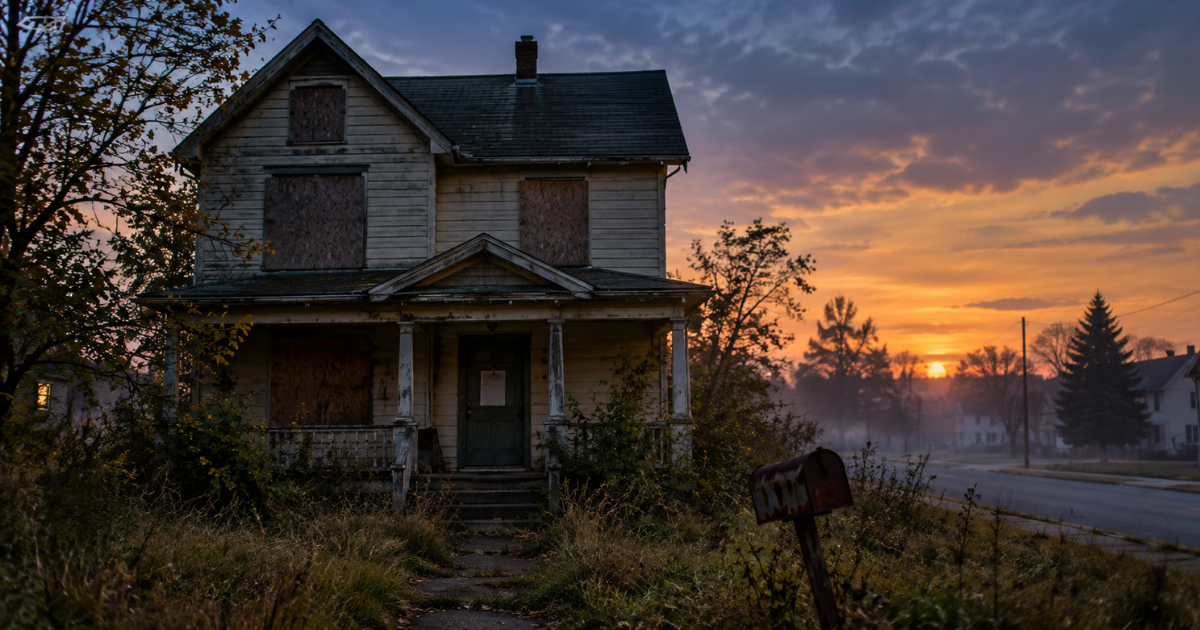
Picture a house on your street that has sat empty for three years. The grass is knee-high, the windows are boarded, and a faded notice is taped to the door. Can the city take it? Can a neighbor buy it cheaply, or move in? Who is even responsible for it?
If you’re wondering what happens to abandoned houses nobody claims, the short answer is that a house that looks abandoned still has a legal owner, and changing that status requires a formal legal process.
Quick Answer
- An empty house is not ownerless. Title stays with the owner named in county records, or with that owner’s estate, until a sale, an inheritance, or a court process changes it.
- Four processes can change a house’s future: probate (after an owner dies), tax enforcement, mortgage foreclosure, and local building-safety enforcement.
- Government ownership is not automatic. It happens only through specific routes such as tax foreclosure, escheat, or land bank acquisition.
- You cannot claim a house by moving in or making repairs. Lawful buying happens through the owner, an estate, or an official or court-supervised sale.
- The rules differ by state and locality. This guide uses examples from West Virginia, Rhode Island, North Carolina, Ohio, New York, Alaska, and California. Each example applies only in its own state, and this article covers US law only.
Key Terms in Plain English
- Probate: the court process that moves a dead person’s property to the people entitled to it.
- Escheat: when property passes to the state because no one can legally inherit it.
- Redemption: the owner’s right to pay what is owed and reclaim a property after a tax sale or foreclosure.
- Mortgagee: the lender that holds the mortgage.
- Lien: a legal claim on a property to secure a debt.
- Receiver: a person appointed by a court to manage or repair a property. A receiver does not become the owner.
- Land bank: a governmental or nonprofit entity that acquires, holds, and manages foreclosed or abandoned properties.
What Does It Mean When Nobody Claims a House?
People use “nobody claims it” for several different situations, and the law treats each one differently.
Vacant, abandoned, or legally ownerless
Start with the statistics. The Census Bureau sorts vacant housing units into categories: for rent, for sale, seasonal, and vacant for some other reason. Its 2020 Census data, published in May 2023, put the national vacancy rate at 9.7%, down from 11.4% in 2010, and found more than 4.3 million vacant seasonal units, the largest category. Those figures count empty units, not abandoned ones. For estimates of how many abandoned houses there are in the US, see our separate guide. The research behind this article found no reliable national count of houses with no legal owner, and vacancy numbers cannot stand in for one.
“Abandoned” has no single definition. The federal Neighborhood Stabilization Program, created in 2008, called a home abandoned when foreclosure proceedings had begun, no mortgage or tax payments had been made for at least 90 days, and the property had been vacant for at least 90 days. A state statute can set its own test:
- West Virginia requires a plaintiff to prove, by a preponderance of the evidence, that no one lawfully lives or runs a licensed business there, or that code violations exist with no continual utility service, or that every mortgagor has sworn an intent to abandon it.
- Rhode Island has a court weigh eight factors to decide whether an owner has “constructively abandoned” a property, and vacancy is only one of them.
| Term | What it describes | Source of the definition |
|---|---|---|
| Vacant | A housing unit counted as unoccupied; the Census sorts these into for rent, for sale, seasonal, and other | Census Bureau |
| Seasonal vacant | A unit used part of the year, from beach houses and timeshares to hunting cabins | Census Bureau |
| Abandoned (program) | Foreclosure begun, 90 days without payments, and 90 days vacant | HUD report on the Neighborhood Stabilization Program |
| Abandoned (statute) | A test written into one state’s law, such as West Virginia’s three alternatives or Rhode Island’s eight factors | State statutes |
| Zombie property | A home the owner abandoned, typically facing foreclosure, that no one maintains | New York Department of Financial Services |
| Foreclosed | A legal process to recover unpaid debt: tax foreclosure for taxing authorities, mortgage foreclosure for lenders | HUD |
| Unsafe or public-nuisance building | A code-enforcement finding about a building’s condition | West Virginia, Ohio |
| Escheated | Property that passes to the state by court judgment when no one can inherit | North Carolina |
Vacancy does not prove abandonment, and abandonment does not prove a property is ownerless. Our guide to abandoned, vacant, zombie, and condemned property explains how these labels differ in practice. The sections below follow legal status, not how the house looks from the street.
What if the owner cannot be found?
An owner who cannot be found keeps the title, and the laws that deal with absent owners are built around that fact.
- Rhode Island lets a building inspector serve notice by publication. When the inspector does, the report to the town treasurer must describe the steps taken to locate the owner.
- Ohio’s nuisance statute allows ordinary mail or publication when certified mail is refused or unclaimed, and it requires a copy of the notice to be posted on the building.
An owner who cannot be found can lose rights through a process designed for that situation, but only after the notice rules have been followed.
What if the owner has died and no heirs are known?
Death does not erase title. The property becomes part of the owner’s estate, and a court-supervised process decides who receives it. An heir nobody has located is different from having no heir at all. North Carolina’s escheat statute, for example, names “unknown heirs” as defendants and serves them by publication. The probate and escheat sections below cover the details.
Why unclaimed-money rules do not settle what happens to a house
Rules written for unclaimed money or other personal property do not answer the question for real estate. A house moves through courts and recorded documents. In North Carolina, the State Treasurer brings a civil action in superior court, and the court may order the land sold, with the proceeds held for later claims.
Who Owns an Abandoned House Nobody Claims?
Ownership turns on records and court status, not on whether anyone is using the building.
The recorded owner may still hold title
Owners walk away from houses for many reasons, but walking away hands the title to no one. The owner’s name stays on the deed, and the debts stay attached to the property. A taxing authority can place a lien on it without the owner’s consent, and a mortgagee keeps its lien until the loan is paid or released. County records are the first place to look for the owner, and a later section explains how to read them.
What happens when the owner dies?
Probate is the court process that moves a dead owner’s property to the people entitled to it. The court appoints a personal representative, who gathers the property, notifies creditors, handles debts and taxes, and transfers title. Some property, such as real estate held with a right of survivorship or under a transfer-on-death deed, passes without probate.
What happens when no eligible heir is found?
North Carolina shows how a house can reach the state. Escheat requires that the owner left no heir who can inherit under state law, and the State Treasurer then sues for a judgment declaring the property escheated.
How lenders and lienholders may be involved
A mortgagee can foreclose on a house whose owner has left or died, and local governments sometimes press the lender to act.
- West Virginia lets a municipality ask a court to compel a mortgagee to start or finish a foreclosure, or to release its lien.
- Ohio’s nuisance statute offers mortgagees and lienholders a chance to do the repair work, in order of priority, before the judge appoints a receiver.
When a government entity may acquire an interest or title
Governments acquire houses through defined routes. HUD describes tax foreclosure as the most common way land banks obtain property. In Rhode Island, a city or town that holds tax title can ask a court to end the owner’s redemption rights. In North Carolina, a house can escheat to a state fund. Each route has its own conditions, covered below.
What Happens When Nobody Pays the Property Taxes?
What tax delinquency does and does not mean
Missing a tax payment does not move title. It lets the taxing authority impose a lien on the property without the owner’s consent, and state law then sets the steps toward a sale. In the process HUD described in 2009, a public auction follows, and a property that does not sell can end up with a land bank or another government owner.
Tax liens, tax sales, and tax deeds
States choose different models. HUD noted that some states allow tax liens to be sold at auction, where buyers are often speculators with no immediate plan to return the property to use. Rhode Island’s statute refers both to a “sale or taking of land for taxes” and to a city or town that holds the acquired title. A buyer may receive a lien, a deed, or a deed still open to redemption, depending on the state and the sale.
Notices, redemption rights, and deadlines
HUD’s foreclosure timeline shows a redemption period after the sale and notes that timelines vary by state. Rhode Island shows one version:
- The building inspector notifies the record owner and, where appropriate, the mortgagee or lessee, who then have 30 days to begin correcting the conditions.
- If no one acts, the inspector reports to the treasurer.
- If satisfied the facts are sufficient, the treasurer records an affidavit and petitions the superior court to foreclose all rights of redemption.
- The court must hear the case within 30 days of its start.
HUD also reported that Georgia’s 1995 judicial tax-foreclosure law cut the redemption period from 12 months to 2. Those numbers belong to their own states and dates.
What happens to other liens and sale proceeds?
Other liens may or may not survive a tax-driven transfer, depending on the law and on who takes title. HUD’s 2009 case studies show the range: the Fulton County/Atlanta land bank could waive back taxes and clear title, while the Genesee County, Michigan, land bank could not extinguish delinquent taxes. Sale proceeds follow a statutory order of payment. Ohio’s receivership statute, covered below, ranks delinquent taxes ahead of earlier mortgages. A buyer who wants clean title needs a title search, not an assumption.
What If the House Has a Mortgage or Other Debts?
Foreclosure runs separately from tax enforcement and can end with a new owner.
How mortgage foreclosure may begin
Missed payments lead to lender notices and then to foreclosure, on a timeline that varies by state. HUD separates judicial foreclosure, where a court or sheriff runs the sale, from power of sale, where the mortgage company runs it.
New York adds a duty for lenders on vacant homes. For a mortgaged one- to four-family house:
- The lender must begin monthly occupancy inspections once the borrower is 90 days behind.
- The home counts as vacant and abandoned after three consecutive inspections find no occupant, no sign of occupancy, and no basic maintenance.
- The lender must then secure and maintain the property (cutting grass, removing garbage, guarding against squatters) and register it with the state within 21 business days. The registry is confidential.
- The duty ends if the borrower files for bankruptcy or is in loss mitigation, if the lender sells the mortgage or releases the lien, if an occupant asserts a right to occupy, or when the foreclosure finishes.
What a foreclosure sale can change
A foreclosure sale can put title in the lender’s hands. In West Virginia, if the mortgagee is the winning bidder, the trustee must deliver a recorded deed within 30 days, and the municipality can seek an injunction to enforce that.
Delay is the problem West Virginia’s Zombie Property Remediation Act targets. After written notice to the mortgagee and 45 days to respond, a municipality may ask a court to order a mortgagee whose loan is in default to start foreclosure within four months and be ready for sale within a reasonable time, up to one year. For a foreclosure already begun, the order can require the mortgagee to move it to sale within four months. A court can instead order the mortgagee to release its lien within three months. The act does not give the city title to the house.
How other liens and claims can affect a transfer
A buyer inherits whatever liens survive. HUD describes clear title as one free of liens and not open to a later claim by a previous title holder.
West Virginia limits its remedy where other claims exist. A municipality cannot use it while the owner is in bankruptcy without the bankruptcy court’s consent, and a secured building that is the subject of a probate action, a quiet-title action, or another ownership dispute known to the servicer does not count as vacant and abandoned.
What Happens When the Owner Dies Without Heirs?
An owner’s death starts an administration process, and only a narrow set of outcomes leads to state ownership.
Probate and estate administration
Alaska’s court system calls probate a court process for transferring a dead person’s property to those entitled to it. Opening a case can give the personal representative legal authority to act, and the process is generally the same with or without a will. Alaska’s courts say probate usually takes between six months and a year and often runs longer when there are debts, disagreements, or trouble finding or transferring property. Other states use different forms and timelines.
Searching for heirs and resolving title
Where there is no will, state law lists who inherits. Two examples:
- Alaska: if no probate was opened and more than three years have passed since the death, a person can ask the court to determine the heirs under intestacy rules, and the resulting order can be used to transfer some types of property.
- North Carolina: an appointed administrator or executor must determine that there are no known heirs or claimants and inform the State Treasurer.
What if no legally eligible successor is found?
North Carolina’s statute answers this directly. When an owner dies intestate, or partly intestate, without heirs who can inherit under state law, the real and personal property escheats. The State Treasurer may sue in the superior court of the county where the property sits, naming the administrator or executor and any unknown heirs or claimants, who can be served by publication. The clerk may enter a default judgment if no one answers.
What escheat means for real estate
Escheat moves property to the state when no one can inherit it. In North Carolina, the Treasurer brings a court action to have the property declared escheated, and the land may be sold after that judgment. The money goes to the Escheat Fund, where it is held subject to any just claims.
What Can the City or County Do About an Abandoned House?
Local enforcement addresses safety and code compliance. It does not by itself transfer ownership.
Code violations, notices, and penalties
Enforcement starts with an inspection and a notice to the owner.
- Rhode Island: the inspector’s notice gives the record owner 30 days from receipt or publication to start correcting the conditions.
- West Virginia: a municipality can adopt an ordinance under §8-12-16 to determine that a property is unsafe, unsanitary, dangerous, or detrimental to public safety or welfare.
- Ohio: a public-nuisance building includes one that is a hazard because of inadequate maintenance, dilapidation, obsolescence, or abandonment.
Fines and liens come from each locality’s own code, so check it directly.
Securing or repairing unsafe buildings
The line between securing a building and repairing it varies. Ohio’s statute defines abatement as correcting the nuisance conditions and rehabilitating the building, and it excludes closing or boarding up. New York’s regulator, by contrast, says boarding up windows may be an appropriate way for a lender to secure a vacant property. Under the federal Neighborhood Stabilization Program, a land bank could maintain property it did not own if it charged the owner the full cost or placed a lien on the property.
Receivership where authorized
Ohio’s receivership statute shows how the tool works, with limits that belong to Ohio.
- Who can ask: a municipality, township, neighbor within 500 feet, tenant, or qualifying nonprofit can ask a court to find a building a public nuisance. The statute covers residential buildings but excludes owner-occupied buildings with three or fewer residential units.
- Hearing: the judge holds a hearing at least 28 days after service.
- Chance to fix: if the owner has had a fair chance to fix the building and has not, the judge offers mortgagees and lienholders the chance to do the work.
- Receiver: if none will, the judge may appoint a receiver, who must file a financial and construction plan and may take possession, collect rents, pay expenses, and hire contractors.
A receiver does not become the owner. Court-approved receivership expenses can become first liens once recorded. If the receiver abates the nuisance, the judge may order a sale after a hearing, and the buyer takes title free of unsatisfied tax liens, while other liens and recorded easements survive. Proceeds go first to the receiver’s notes and approved expenses, then to approved lienholder spending, then to delinquent taxes, then to earlier mortgages and liens.
Public acquisition, land banks, and rehabilitation programs
HUD defines land banks as governmental or nonprofit entities that acquire, hold, and manage foreclosed or abandoned properties, enabled by state legislation and set up by local ordinance. They acquire property through tax foreclosure, intergovernmental and nonprofit transfers, and open-market purchases. Their powers differ: the Atlanta-area land bank could clear title and waive back taxes, and Genesee County’s could not extinguish taxes. HUD’s 2009 list of states with land bank laws included Michigan, Ohio, Georgia, Indiana, Texas, Kentucky, and Maryland, and the current list needs a separate check. The 2008 federal housing law behind the Neighborhood Stabilization Program allowed grantees to buy and rehabilitate abandoned or foreclosed homes, establish land banks, and demolish blighted structures.
When demolition may be permitted
Authority depends on the state and the locality. In Ohio, a judge may order demolition at an interested party’s written request when repair is not feasible, but only after the requester pays the demolition and receivership costs. West Virginia’s act leaves in place a municipality’s separate power under §8-12-16 to dispose of unencumbered properties that are unsafe, unsanitary, dangerous, or detrimental. HUD reported that the Genesee County land bank demolished between 100 and 200 blighted structures a year.
What Can Eventually Happen to the House?
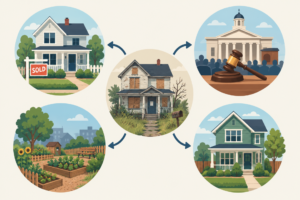
The table sets the main paths side by side. A property may follow one of them for years or move from one to another.
| Trigger | Who acts | Process | Possible result for the house | Example |
|---|---|---|---|---|
| Owner dies, heirs known | Probate court, personal representative | Estate administration | Title passes to heirs or beneficiaries, or the estate sells | Alaska |
| Owner dies, no eligible heir | State treasurer, superior court | Escheat action | Judgment, sale, proceeds held for claims | North Carolina |
| Unpaid property taxes | Tax collector, treasurer, court | Lien, sale or foreclosure | Auction, municipal or land-bank ownership, end of redemption rights | Rhode Island, HUD |
| Mortgage default | Lender, trustee or court; a municipality can press | Foreclosure | Sale to a bidder or the lender, or release of the lien | West Virginia, New York |
| Unsafe or nuisance building | Municipality, neighbor, nonprofit, court | Code enforcement, injunction, receivership | Repair, court-ordered sale, or demolition | Ohio |
| Land bank acquisition | Land bank | Tax foreclosure, transfers, purchases | Rehabilitation, resale, side-lot transfer, or demolition | HUD |
It may remain vacant while legal issues are unresolved
Delay can run long. HUD reported that under Michigan’s former tax-foreclosure laws, unsold properties reached state ownership through a process lasting four to seven years, before the state’s 1999 reform. In Baltimore, HUD found that acquiring and disposing of a single city-owned property could take up to three years.
It may be maintained or rehabilitated
A receiver in Ohio, a land bank, or a new owner can restore a house. HUD reported that the Genesee County land bank renovated 25 to 50 abandoned houses a year. West Virginia’s act also excludes an unoccupied building under diligent renovation from its definition of vacant and abandoned.
It may be sold or transferred through a lawful process
Probate transfers, tax and foreclosure sales, receiver sales, and escheat sales are different processes, and the buyer’s rights depend on which one produced the sale. Always ask which one it was.
It may enter a public program or be demolished
In land bank systems, the lot often outlasts the house: nearly 3,400 of the 4,200 properties in the Genesee County land bank’s February 2009 inventory were vacant lots.
What Happens to Abandoned Houses Over Time?
That is what happens to abandoned houses left empty while the legal process runs. Without heat, ventilation, and small repairs, water finds its way in first. A roof leak or a broken window lets moisture into walls and floors, and that moisture brings rot and mold.
Plants, pests, and people add to the damage. Overgrowth, insects, and rodents move in when a house is quiet, and broken windows or open doors can invite vandalism and the stripping of copper, fixtures, and appliances. Each season makes the next repair more expensive.
Neighbors feel the change first. An empty, decaying house can lower the appeal of a street, draw complaints to code enforcement, and become a safety concern. That is why the city or county section above focuses on condition, not just ownership.
Can Someone Claim or Buy a House Nobody Claims?
A buyer can purchase one through the right channels, and current abandoned houses for sale show what is on the market, but a person who simply moves in cannot take one. The lawful routes run through the owner, the estate, or an official or court-supervised sale.
Buying from the owner or authorized representative
Only the owner or someone with legal authority can sell. For a dead owner’s house, that authority comes from the court’s appointment of a personal representative. Ask to see proof of the appointment, and have the title checked before paying.
Buying through a verified tax sale or foreclosure auction
Confirm with the office running the sale that it is real and current, then learn what the buyer receives. HUD noted that tax-lien buyers are often speculators with no plan to reuse the property. In Rhode Island, a city holding tax title ends the owner’s redemption rights through a superior court proceeding, so a buyer needs to know whether that step is finished.
Why adverse possession is not an automatic shortcut
Adverse possession lets a person gain title by occupying land under rules a state writes into law. California’s statute, for a claim not based on a written instrument, counts possession only where the land was protected by a substantial enclosure or was usually cultivated or improved. The claimant must also show five continuous years of occupying and claiming the land and timely payment of all taxes for those years, proven with certified county tax records. Other states set different periods and tests, and a court must decide the claim.
Why entering, repairing, or paying bills may not establish ownership
An empty look gives no permission to enter. Entering a house you do not own can lead to trespassing claims, and changing locks or making repairs does not move title. In California, paying taxes is one element among several, and a court must approve the whole claim.
Due diligence checklist before buying a distressed or estate property
- Confirm the record owner and check whether a probate case is open.
- Order a title search to find liens, open tax debts, and any recorded sale or foreclosure notices.
- Ask the treasurer or tax collector about delinquent taxes and any redemption period.
- Ask the building department about open code cases, unsafe-building findings, and demolition orders.
- Confirm in writing who has authority to sign the deed.
How to Find Out What Happened to a Specific House
Public records can answer many of these questions without anyone setting foot on the property.
Search the county assessor and recorder or register of deeds
The assessor’s page lists a parcel number, an owner name, and a mailing address. The recorder or register of deeds holds deeds, mortgages, liens, and releases. An assessor entry alone may not settle who holds title. In Rhode Island, the treasurer must record an affidavit in the registry of deeds before petitioning the court in an abandonment case, so the recorder’s files can show a case in progress.
Check tax, court, and probate records
The treasurer or tax collector can say whether taxes are delinquent and whether a sale is scheduled. The probate court can show whether an estate was opened in the owner’s name. Civil court records show foreclosure and nuisance filings. In Alaska, the court’s online CourtView lists what has been filed in a case, though not the documents themselves.
Contact code enforcement or the local housing department
Ask whether the address has open cases, unsafe-building findings, or orders. In New York, residents can report a vacant and abandoned house to the state’s Department of Financial Services by hotline or online. The department then tries to find out whether the property is mortgaged and who is responsible for it, and it asks callers to pass along any contact information posted on the property. The registry itself is not public.
Confirm auction status and title through reliable records
Check the sale notice with the sheriff, trustee, treasurer, or court that runs it, and compare it with the recorded documents. A title company or attorney can run a full search.
Avoid trespassing and unauthorized entry
Work from the public sidewalk and from records. The visible signs of a truly abandoned house can tell you whether a property is worth researching, but they are not proof of who owns it. Do not enter, remove posted notices, or change locks. If a notice on the door names a lender or a contact, copy the details down from outside and give them to the agency that handles complaints.
Why the Answer Changes by State and Locality
Several details move from state to state: who may bring an action, how long the notice period runs, whether an owner or lender keeps a right to redeem or respond, whether a city can obtain title, and how “abandoned” is defined. Local ordinances add another layer, since several of these statutes work through municipal action. A reader in another state needs that state’s statute and the local code.
The examples in this article have these limits:
- West Virginia’s Zombie Property Remediation Act compels mortgagees to move on stalled foreclosures and gives government no title. Its power belongs to a municipality, or to a county commission outside city limits.
- Rhode Island’s §44-9-25.2 applies after a sale or taking for taxes, when the city or town holds the title.
- North Carolina’s escheat provision applies only when no heir can inherit, and it works through a lawsuit by the State Treasurer.
- Ohio’s receivership statute covers residential buildings other than owner-occupied buildings with three or fewer units, and it opens the action to neighbors and nonprofits as well as local governments.
- New York’s lender duties cover mortgaged one- to four-family homes and do not reach unmortgaged houses, vacant lots, or larger buildings.
Frequently Asked Questions
Does an abandoned house eventually belong to the government?
Not automatically. Public ownership comes through a specific process, such as tax foreclosure, escheat, or land bank acquisition, and each has conditions and notice rules.
Who owns a house if nobody claims it?
The recorded owner or that owner’s estate, until a legal process changes it. The county recorder and the probate court hold the records that show which.
What happens if the owner dies without a will or known heirs?
The estate goes through probate, where state law decides who the heirs are. In North Carolina, the house escheats only if no one can inherit, and the Treasurer then seeks a court judgment.
Can a city take or demolish an abandoned house?
A city can enforce its codes and, in some states, ask a court for a receiver or a demolition order. Taking title takes a separate route such as tax foreclosure. In Ohio, demolition needs a court order and payment of the costs by the requester.
Can someone buy an abandoned house for free?
Not through any process described here. Houses change hands by purchase from an owner or estate, or through a tax, foreclosure, or court-ordered sale. Some land bank programs transfer vacant lots, not houses, to neighbors for a nominal fee. To see what is on the market locally, browse listings near you.
Can you move into a house that appears abandoned?
No. Apparent vacancy gives no permission to enter, and the owner, an estate, or a lender may hold rights in the property.
Can you claim a house through adverse possession?
Only through a court-proven claim that meets a state’s own requirements. California’s include five years of continuous possession and timely tax payments.
How do you find the owner of an abandoned house?
Start with the county assessor and recorder, then the treasurer, the probate court, and the local building department, as described above.
What happens to unpaid property taxes?
They become a lien, and state law sets the path to a sale or foreclosure. Rhode Island’s 30-day notice and 30-day hearing are one example, not a national rule.
How long can a house remain unclaimed?
No single period applies. West Virginia’s act uses a 45-day notice and four-month foreclosure deadlines, Rhode Island uses a 30-day notice and a hearing within 30 days, and Alaska’s courts say probate usually takes six months to a year. Those clocks belong to separate processes and do not add up to one.
What happens if you explore an abandoned house?
Exploring an abandoned house can lead to trespassing charges, even if it looks empty, and the house may be unsafe. Work from the public sidewalk and from county records instead of going inside.
Conclusion
When a house looks claimed by no one, the useful question is which legal process applies to it: an estate, a tax debt, a mortgage, a building-code case, or none yet. The answer sits in county records, court dockets, and the local building department, and it determines who can sell the property, who can be sued, and who is entitled to notice.
Readers with a particular property in mind can start with the assessor, recorder, treasurer, and probate court, then ask a local attorney or title company to read the results. For the wider picture, see our overview of abandoned houses in America.
This article describes general legal processes and a few state examples. It is not legal advice, and statutes change.

AbandonedHouse
We explore the history, architecture and context behind America’s overlooked places through research-led storytelling and responsible documentation.
More stories for curious minds

Pros and Cons of Buying an Abandoned House
A run-down house with a low price can look like a steal, and the pros and cons of…

How to Buy an Abandoned House: Step-by-Step (US)
How to buy an abandoned house: find a property, identify the owner through county assessor and tax records,…